
Every week, traders are flooded with information.
Financial television discusses headlines. Research firms publish economic forecasts. Newsletters explain why markets moved yesterday. Social media offers thousands of opinions about what might happen tomorrow.
The challenge is not finding information. The challenge is determining what information is actually useful for making trading decisions. At the Owl Bundle User Group (OBUG), we have been researching a different question:
Can market structure be measured in a way that helps traders make better decisions?
That question eventually led to the development of the OBUG Tactical Framework (OTF). The OBUG Tactical Framework represents our attempt to integrate many of our research efforts into a practical weekly assessment of market structure and tactical trading conditions.
Much of our research builds upon concepts originally developed and taught by Dr. Ken Long, particularly his work involving RL30Slope Z, market state identification, and empirical trading-system development. Markets can often be understood more effectively by measuring trend behavior, breadth, leadership, and acceleration than by attempting to predict future events. Much of the underlying data used in OTF is collected through automated scans, backtests, and analysis performed within the EdgeRater platform.
Most Market Commentary Describes. OTF Attempts to Measure.
Most market services focus on observations such as: “Technology is leading, Institutions are buying, Risk appetite is improving, Inflation concerns are rising, or Small caps are beginning to outperform”.
These observations may be correct. The problem is that they are often subjective. Two analysts can look at the same market and arrive at completely different conclusions.
Our objective is different. Rather than asking: What story sounds most convincing? we ask: Can the underlying market behavior be measured directly?
That philosophy drives everything we do at OBUG.
The Foundation: measuring market behavor
Markets are constantly transmitting information through price behavior, leadership changes, breadth expansion, sector rotation, and cross-asset relationships.
Rather than attempting to predict future events, OTF focuses on measuring market behavior through breadth, leadership, trend acceleration, macro alignment, and cross-asset rotation. The objective is simple: Understand what market conditions appear to be doing right now.
The OBUG Tactical Framework (OTF)
OTF combines multiple evidence streams into a single tactical assessment of market conditions.
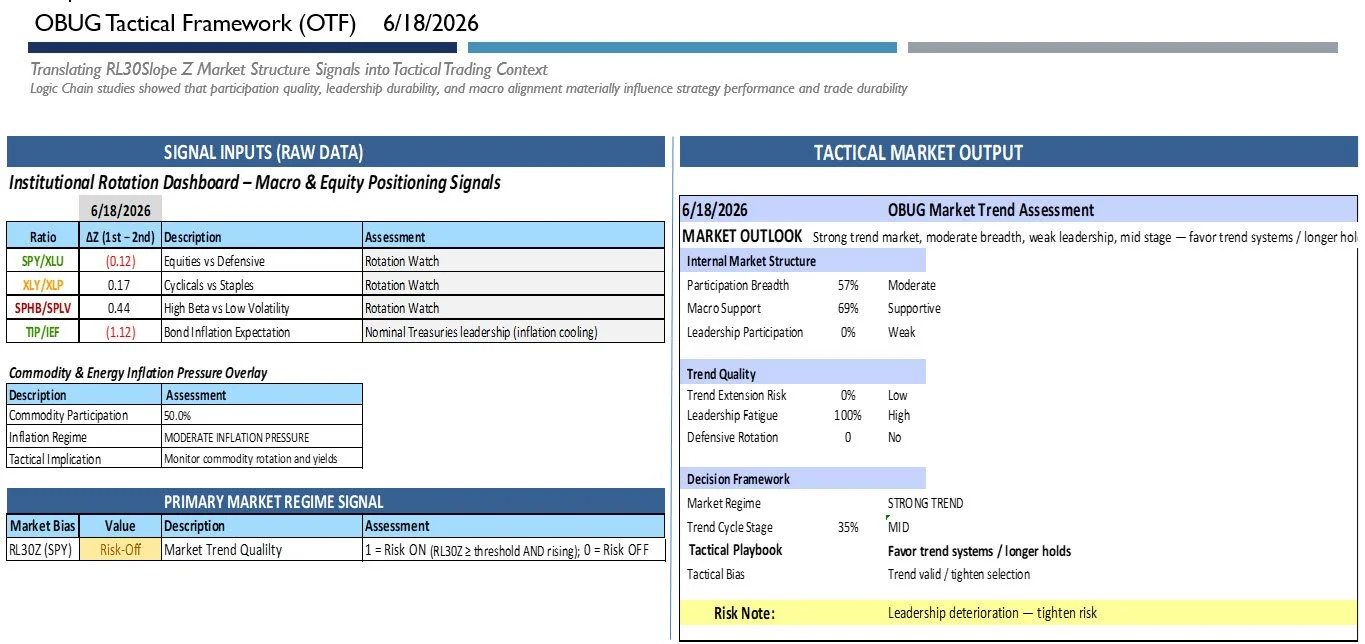
OTF Dashboard Overview
The OBUG Tactical Framework summarizes participation breadth, leadership participation, macro support, trend extension risk, defensive rotation, and overall market regime into a single tactical assessment. Instead of relying on a single indicator, OTF evaluates multiple dimensions of market structure simultaneously.
Why does this matter?
Many trading systems perform differently under different market conditions.
Trend-following systems often perform best when breadth and leadership are expanding. Mean-reversion systems may perform better when leadership deteriorates and participation narrows. Position sizing, hold times, and trade selection may also need to adapt as market conditions change.
OTF attempts to identify these conditions before trades are placed, helping traders align tactics with the prevailing market environment.
Looking Beneath the Index
Many traders focus almost exclusively on the S&P 500. But market leadership often changes before the index itself changes. OTF therefore measures the relationships between assets that reveal institutional positioning beneath the surface.
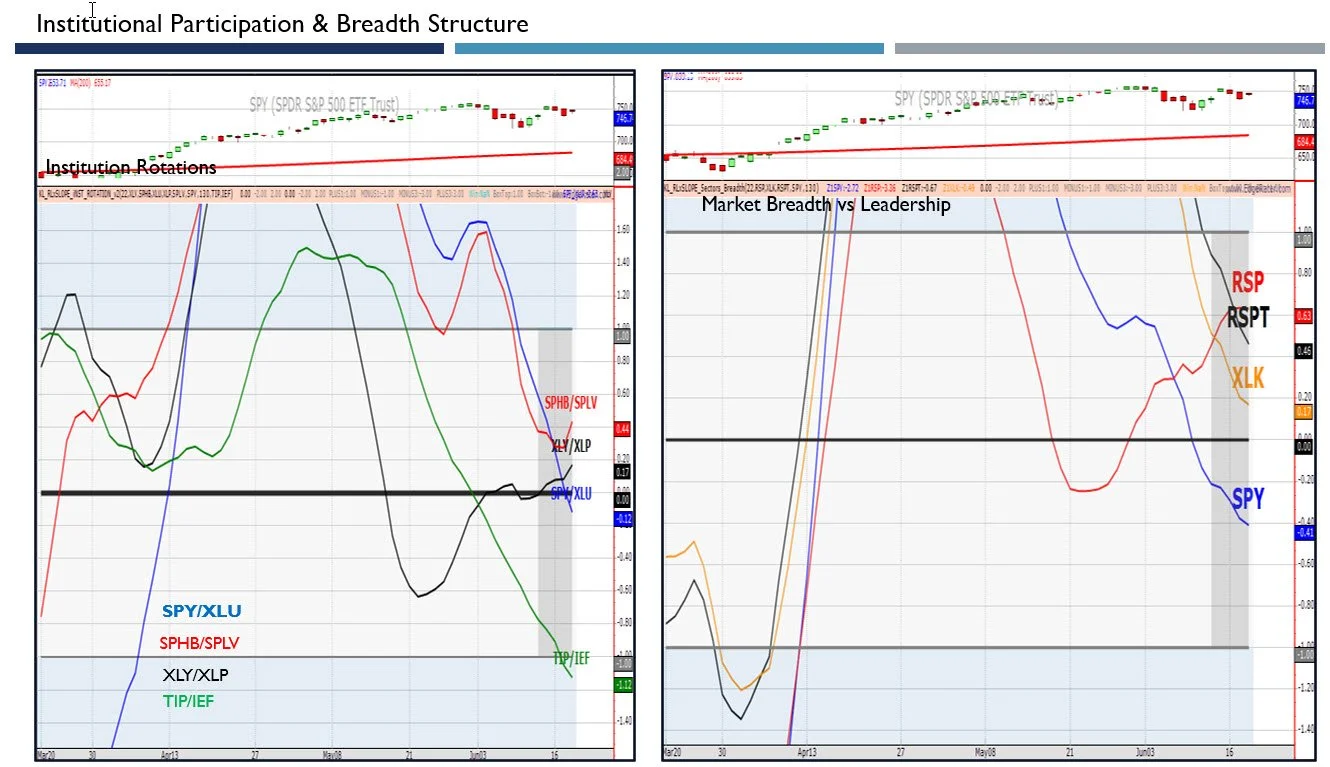
Institutional Participation & Breadth Structure
OTF evaluates risk appetite, defensive rotation, inflation expectations, and leadership participation using relative-strength relationships between key ETFs and asset classes.
Examples include:
SPY vs Utilities
Consumer Discretionary vs Consumer Staples
High Beta vs Low Volatility
TIP vs Treasury Bonds
These relationships help determine whether market behavior is becoming more aggressive or more defensive. Rather than asking whether the market is up or down, we ask: What type of market behavior is driving current conditions?
Macro Context Matters
Many trading systems perform differently depending on the macro environment. OTF attempts to measure that environment rather than relying on economic forecasts.
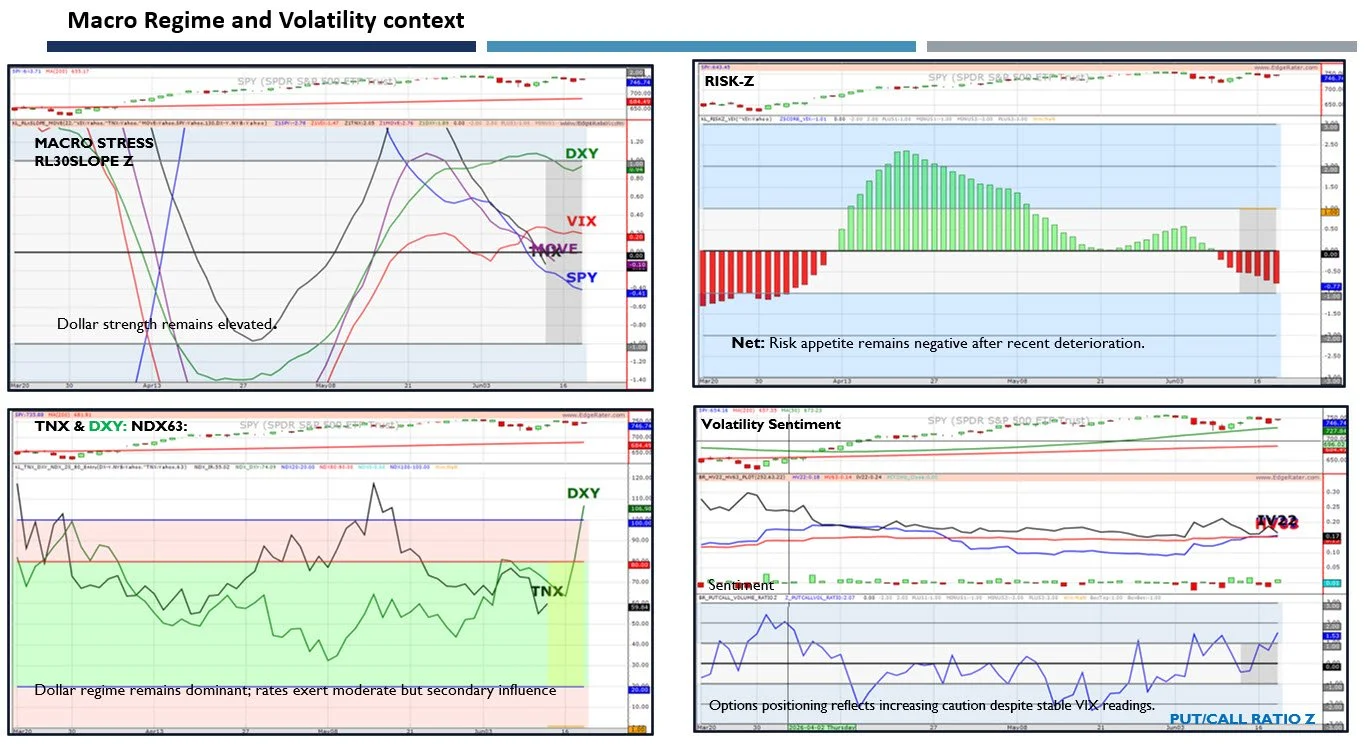
Macro Regime & Volatility Context
OTF evaluates volatility, sentiment, interest rates, currency trends, and risk appetite to provide context for tactical decision making.
This includes monitoring:
RiskZ sentiment measures
Treasury yields
U.S. Dollar trends
Volatility conditions
Options sentiment
The objective is not to predict the next economic report. The objective is to understand the environment in which trades are being placed.
understanding cross-asset rotation
Market leadership and relative strength often shift before headlines explain why. This is one reason OTF includes extensive cross-asset analysis.
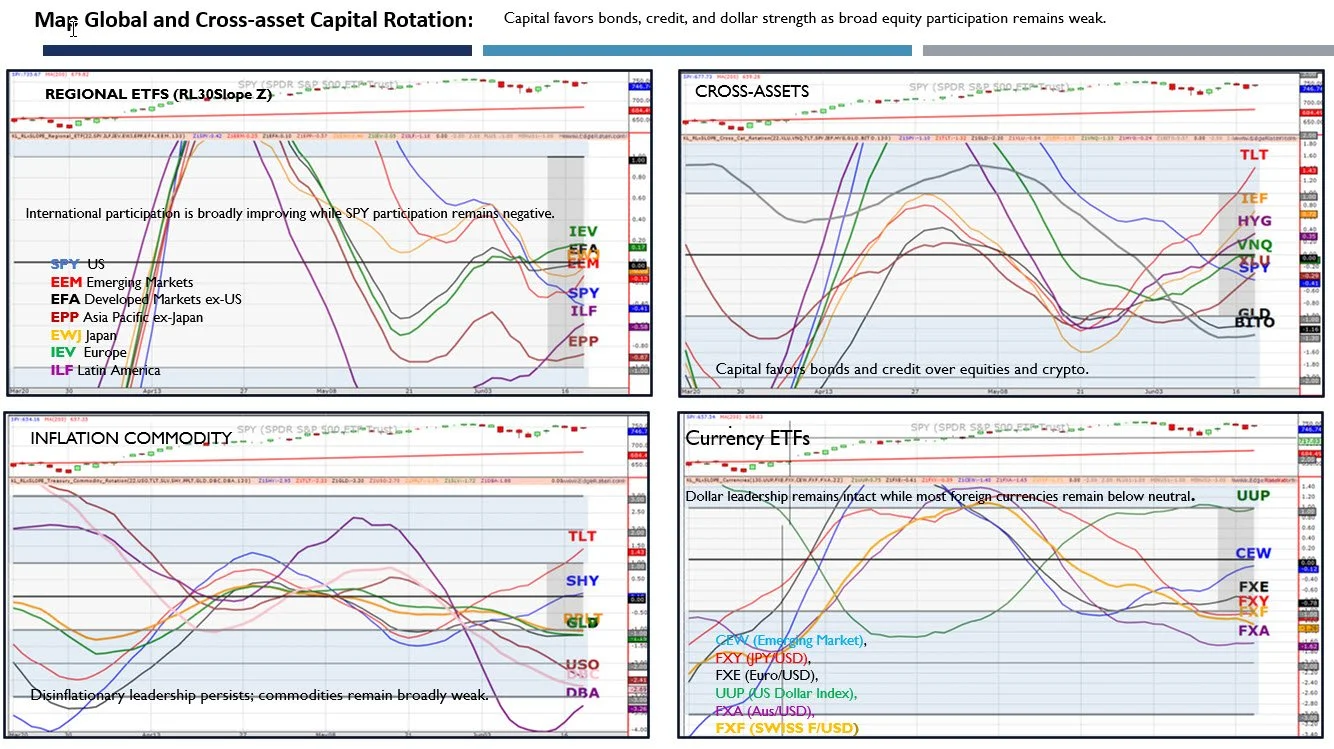
Global & Cross-Asset Rotation using RL30Slope Z
OTF tracks relative strength, trend behavior, and rotation across equities, bonds, commodities, currencies, and international markets using RL30Slope Z scores.
By monitoring:
Bonds
Credit
Commodities
Currencies
International markets
we can observe where relative strength and weakness are emerging across asset classes. These shifts often provide useful context for sector leadership and market breadth.
Why We Use RL30Slope Z
Much of OBUG's research has been built around RL30Slope Z, a concept popularized by Dr. Ken Long and subsequently expanded through years of OBUG research and testing.
RL30Slope Z attempts to measure whether trend acceleration is improving or deteriorating relative to a symbol's own historical behavior.
Rather than focusing solely on price direction, RL30Slope Z focuses on:
Trend acceleration
Trend deceleration
Momentum expansion
Momentum contraction
This perspective has become a foundation for several OBUG research initiatives, including Logic Chain, ORPA (OBUG RL30Slope Z Participation Analyzer), market participation studies, and leadership development research.
Rather than asking: Is price rising? we ask: Is trend acceleration improving in a way that may indicate increasing sponsorship and participation?
Translating Market Structure Into Trading Decisions
The goal of OTF is not to generate buy and sell signals. Instead, it seeks to provide context for decision making.
For example:
Trend traders may use OTF to determine whether breadth and leadership are expanding.
Swing traders may use OTF to assess whether market and sector conditions are aligned.
Position traders may use OTF to identify developing leadership and sponsorship.
Risk managers may use OTF to evaluate whether conditions support aggressive or defensive positioning.
In many ways, OTF attempts to answer a more important question than: What should I buy today? Instead, it asks: What kind of market am I trading in right now?
What OTF Is — and Is Not
OTF is not intended to predict future market direction or generate automatic buy and sell signals.
Instead, it provides a structured assessment of current market conditions so traders can better align tactics, position sizing, risk management, and system selection with the prevailing environment.
A strong OTF reading does not guarantee market gains. A weak OTF reading does not guarantee market declines.
Rather, OTF attempts to answer a different question: What type of market environment are traders operating in right now?
By measuring breadth, leadership, trend behavior, macro context, and cross-asset relationships, OTF seeks to provide a framework for understanding market conditions before individual trade decisions are made.
Looking Ahead
The OBUG Tactical Framework continues to evolve.
Recent research initiatives include:
ORPA (OBUG RL30Slope Z Participation Analyzer)
Sponsorship persistence
Leadership durability
Theme analysis
Candidate prioritization research
Emerging leadership studies
Our objective remains unchanged:
Build a practical framework that helps traders understand market structure, sector rotation, leadership development, and tactical trading conditions.
Markets will always generate opinions. We believe traders benefit most from evidence. That belief continues to guide every OBUG research project and every weekly OTF Market Scan.
What Makes OBUG Different?
The OBUG Tactical Market Scan is provided to OBUG members as part of their membership. Our goal is simple: Help traders move beyond headlines and narratives toward a more evidence-based understanding of market behavior.
Our focus is increasingly centered on validation. When we observe something in the market, we attempt to test it.
Examples include:
Logic Chain studies
Market structure studies
ORPA sponsorship research
Validation studies
Characterization studies
Rather than asking: Does this idea sound reasonable? we ask: Can it be measured and validated? That research-first approach has become one of the defining characteristics at OBUG.