
Inside the Owl Bundle User Group (OBUG) we recently ran a series of systematic studies on something many traders intuitively believe:
If Market and Sector conditions align, trades should perform better.
This idea sits at the heart of what Dr Ken Long calls the Logic Chain framework:
Market → Sector → System → Symbol
But rather than accepting this trading narrative, we decided to test it.
So we designed a structured research project using Dr. Ken Long’s Swing Systems and ran extensive back tests inside EdgeRater.
The Research Question
We wanted to answer a simple but important question:
Does Logic Chain improve the performance of Swing Systems?
More specifically:
Does it increase profitability?
Does it reduce drawdowns?
Does it improve risk-adjusted returns?
To answer that, we tested several of Dr Ken Long’s Swing systems strategies including: MPRC, ORL, CH, 5DD, TS, and WO.
We evaluated each system under three structural conditions:
1. No Logic Chain — Trade signals whenever the system triggers.
2. Sector Alignment Only — Trade signals only when the sector aligns with the system triggers.
3. Market + Sector Alignment — Trade signals only when both market and sector conditions align with the system triggers.
The First Surprise
The data showed something unexpected.
Logic Chain does not create the Swing System edge.
The Swing Systems themselves already contain the edge.
Instead, Logic Chain performs a different function:
It determines where the edge should be deployed.
That distinction turned out to be extremely important.
What Actually Improved
At first glance the results looked modest.
Some systems showed small performance improvements. Others changed very little.
But when we examined the results more deeply, something important emerged.
We looked at losing streaks. That’s when the real insight appeared.
Losing Streak Compression
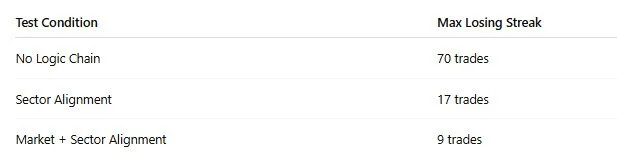
When we compared the backtests, we saw a dramatic difference in the worst losing streaks.
For example, the MPRC system showed the following maximum losing streaks:
Other systems showed similar behavior.
The Logic Chain framework dramatically reduced clusters of losing trades.
Why Losing Streaks Matter
In systematic trading, large drawdowns rarely come from a single trade.
They occur when losses cluster together.
A trading system may encounter a hostile market regime where its edge temporarily disappears. During those periods:
Mean reversion systems keep buying falling markets
Momentum systems chase exhausted trends
Signals keep firing — but the environment is wrong
This produces loss clusters.
What Logic Chain does is filter many of those hostile environments.
Drawdown Compression
Once losing streak clusters shrink, something important happens:
Drawdowns compress dramatically.
In our research we observed examples such as:

This represents a major improvement in risk efficiency.
The Key Insight
After studying the data, the conclusion became clear:
Logic Chain is not a trading signal filter.
Instead, it functions as a portfolio construction framework.
Rather than eliminating trades, it helps traders prioritize where capital should be deployed first. .
How Traders Can Implement Logic Chain
Based on the research, the implementation is straightforward:
1) Run Swing System scans normally
Use your curated symbol list.
2) Identify Market and Sector alignment
3) Rank signals based on alignment strength
When capital is limited:
First prioritize trades where Market + Sector align
Next consider Sector-only alignment
Finally consider system signals alone if capital allows
The position size depends on how strongly the different layers align. This approach preserves the edge of the trading systems while improving portfolio risk efficiency.
Why This Matters for Traders
Many traders try to solve drawdowns by adding:
more indicators
more filters
more complicated strategies
But often the real solution lies in portfolio architecture.
Logic Chain works because it helps avoid regime-mismatch trades, which:
compress losing streak clusters
reduce drawdowns dramatically
improve risk-adjusted returns
allow larger position sizing
Final Takeaway
The Logic Chain research revealed a simple but powerful insight:
Swing Systems generate the edge.
Logic Chain determines where that edge should be deployed.
When those two layers work together, trading becomes significantly more stable.
Join the Owl Bundle User Group
If you enjoy research-driven trading and systematic market analysis, you will likely feel right at home inside OBUG. Each week we explore ideas exactly like this — testing them, challenging them, and refining them together. You can learn more about the Owl Bundle User Group at this link: OBUG
This material is provided for educational and research purposes only. Results are based on historical backtesting and do not represent actual trading performance. Past performance is not indicative of future results. This is not investment advice or a recommendation to buy or sell any security.