Our next system development project at the Owl Bundle User Group (OBUG) is the Logic Chain Trading System. The Logic Chain System is inspired by the work of Dr. Ken Long and is being implemented using EdgeRater for large-scale backtesting, multifactor analysis, and Monte Carlo validation. This project represents a natural evolution in how we think about markets, sectors, systems, and symbols — and how they should work together in a disciplined trading framework.
Rather than asking, “What stock should I trade?”, the Logic Chain asks: Under current conditions, where is capital flowing — and which trading edge is structurally aligned with that flow?
The Core Idea: The Logic Chain
The Logic Chain framework organizes trading decisions into a clear, hierarchical process:
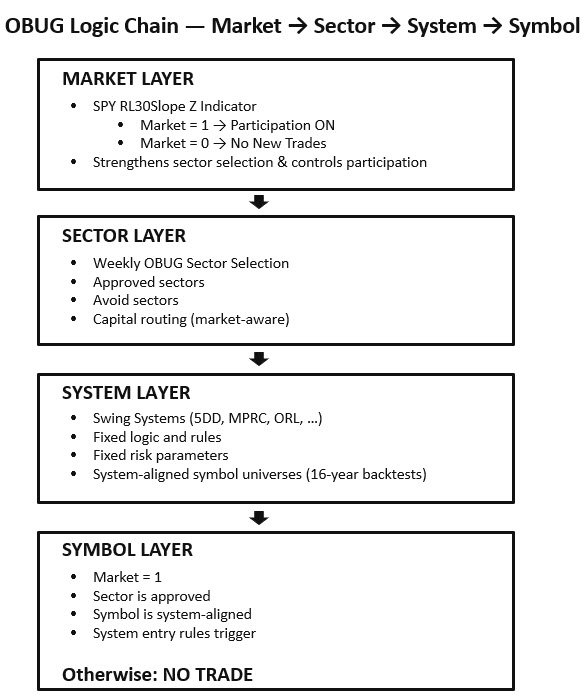
Each layer has a specific and well-defined role:
Market context provides participation guidance and strengthens sector selection
Sector selection determines where capital is eligible to flow
Systems define the trading edge and execution logic
Symbols are traded only when all upstream conditions align
This structure enforces discipline and removes ambiguity. When conditions do not align across the chain, no trade is taken — by design.
Why Build a Logic Chain System?
Many trading strategies fail not because their entry rules are flawed, but because of structural weaknesses in how they are applied:
Symbols are traded without regard to sector context
Sectors are traded without regard to market conditions
Systems are applied indiscriminately across environments
Risk is evaluated trade-by-trade instead of at the portfolio level
The Logic Chain System addresses these weaknesses by separating responsibility across layers and ensuring that each decision is made at the correct level.
This approach is not about finding more trades.
It is about taking fewer, higher-quality trades with better risk control.
The Institutional Parallel: How Capital Is Actually Allocated
The Logic Chain framework mirrors how major institutions and professional asset managers allocate capital.
Institutions rarely begin with individual securities. Instead, they ask:
Where is capital allowed to flow under current conditions?
That decision is made top-down and revisited regularly—often weekly or monthly—based on observed market behavior, risk conditions, liquidity, and mandate constraints.
At a high level, the institutional allocation process looks like this:
Market context determines overall participation and risk appetite
Sector and asset-class rotation determines where incremental capital is eligible
Strategy or style selection determines how capital should be deployed
Instrument selection provides execution once all upstream conditions align
This reflects a Logic Chain in practice —even if it is not labeled as such.
Institutions are generally responding to observed conditions rather than forecasting outcomes, routing capital toward areas that meet predefined criteria and withholding capital when alignment is absent.
How We’re Building It
Long-Horizon System Backtesting
Each Swing System is evaluated using 16 years of historical data across a broad universe of liquid equities. The objective is to identify structural system–symbol compatibility across multiple market regimes. Each system ultimately results in a pre-defined, system-aligned symbol universe.
Sector Attribution (Not Optimization)
Symbols are tagged by sector to understand where each system naturally expresses edge. Sectors are treated as context and capital routing, not as curve-fitting tools.
Monte Carlo Validation
We use Monte Carlo analysis to examine:
Distribution of outcomes
Left-tail risk
Drawdown behavior under adverse sequencing
This step shifts the focus from average performance to robustness under stress.
Below is a NotebookLM video overview of our Logic Chain Framework.
What Comes Next
The Logic Chain Trading System will be studied, tested, and refined inside the Owl Bundle User Group (OBUG) as an ongoing research and development effort, not as an already-finished or guaranteed trading system.
As with all AbleWayTech projects:
Assumptions will be tested
Results will be documented
Weaknesses will be exposed—not hidden
There is no guarantee that this research will result in a deployable or superior trading system.
Some ideas may advance.
Some will be modified.
Some may be abandoned entirely.
That uncertainty is not a weakness—it is a core part of a disciplined learning and system-development process.
Our goal is not to promise certainty, but to work towards a repeatable, defensible trading system that stands up across market cycles.
Joining the Owl Bundle User Group (OBUG)
OBUG is where this kind of work happens.
Members don’t just see finished systems — they see how systems are built, why design decisions are made, and how risk is evaluated across time and regimes.
If you’re interested in:
Developing a structured trading framework
Understanding how market, sector, and system layers interact
Learning through real research rather than hindsight examples
We invite you to join the Owl Bundle User Group (OBUG) and follow the Logic Chain System as it is developed.
— AbleWayTech